Solar panels for flats and renters: your options in 2026
Solar panels for flats explained: approved plug-in balcony kits, shared rooftop schemes, flat roofs and landlord permission, with real UK costs and savings.
We may earn a commission if you buy through links on this page, at no extra cost to you. As an Amazon Associate we earn from qualifying purchases. It never changes what we recommend.How we make money
Solar options if you rent or live in a flat
| Option | Upfront cost | Permission needed | Best for |
|---|---|---|---|
| Plug-in balcony kit | £450 to £850 for an approved kit | Landlord or freeholder, plus a notice to your network operator | South-facing balconies and gardens |
| Portable panel and power station | From a few hundred pounds | None | Camping, power cuts, small loads |
| Community energy shares | Often from £50 to £250 | None | No balcony or outside space |
| Rooftop solar fitted by the landlord or building | Paid by the owner | Owner's decision | Houses and blocks with suitable roofs |
Prices are typical ranges from UK retailers and community energy schemes, November 2026. Check current offers before buying.
Solar panels for flats are now a real option in the UK: since 27 August 2026 you can plug an approved one or two panel kit into a normal socket on your balcony, wall or garden, with no electrician. If you rent or own a leasehold flat, you still need consent to fix anything to the building, and rooftop panels remain the freeholder’s call. On a south-facing balcony in Kent, an 800 W kit makes around 600 kWh a year, worth roughly £95 if you use most of it at home.
The other routes are shared rooftop schemes for whole blocks, portable panels with a power station, and community energy shares. We compared them on cost, who has to agree, and what each one actually saves.
Can you put solar panels on a flat?
The honest answer depends on what you control. Rooftop solar is the cheapest power per kWh, but on a block of flats the roof almost always belongs to the freeholder, and fitting panels is a building project with scaffolding, structural checks and a decision about who gets the electricity.
That is why so few flats have panels. Sunsave’s analysis of MCS installation data found that about 11.7% of UK domestic solar systems are on flats, while the 2021 Census (ONS) put about 21.7% of households in flats. Leasehold makes it harder still: almost every flat sold in England is leasehold, and the lease normally keeps the roof and outside walls with the freeholder.
So split the question in two:
- Things you can do yourself: an approved plug-in kit on a balcony, wall or garden, a portable panel and power station, a community energy investment, or a greener tariff.
- Things the building owner has to do: rooftop panels feeding communal areas, or a shared system that sends power to each flat.
Solar options for flats compared
| Option | Typical cost to you | Who has to agree | Rough yearly saving | Moves with you |
|---|---|---|---|---|
| Plug-in kit on a balcony or wall | £450 to £899 for approved kits we checked | Landlord or freeholder for fixings, plus a notice to your network operator | About £55 to £130 | Yes |
| Plug-in kit in a garden or on a flat roof you control | £509 to £899 | As above | About £110 to £135 | Yes |
| Shared rooftop system (each flat gets a share) | Usually paid by the owner; installed cost £1,500 to £3,500 per flat (UKGBC) | Freeholder, and often the council for planning | Depends on share; Allume quotes around 40% off bills | No |
| Rooftop panels for communal supply only | Paid via service charge or the owner | Freeholder | Lower service charge, not your own bill | No |
| Portable panel and power station | From about £219 for a small power station | Nobody | Little to nothing on bills | Yes |
| Community energy shares | Minimum investments vary by scheme | Nobody | Interest, not bill savings | Not applicable |
Saving figures for plug-in kits use PVGIS output for Maidstone and Ofgem’s 26.32p per kWh price cap rate for October to December 2026, assuming you use 60% of what the panels make. Kit prices come from the retailers’ UK sites, checked 18 to 24 November 2026.
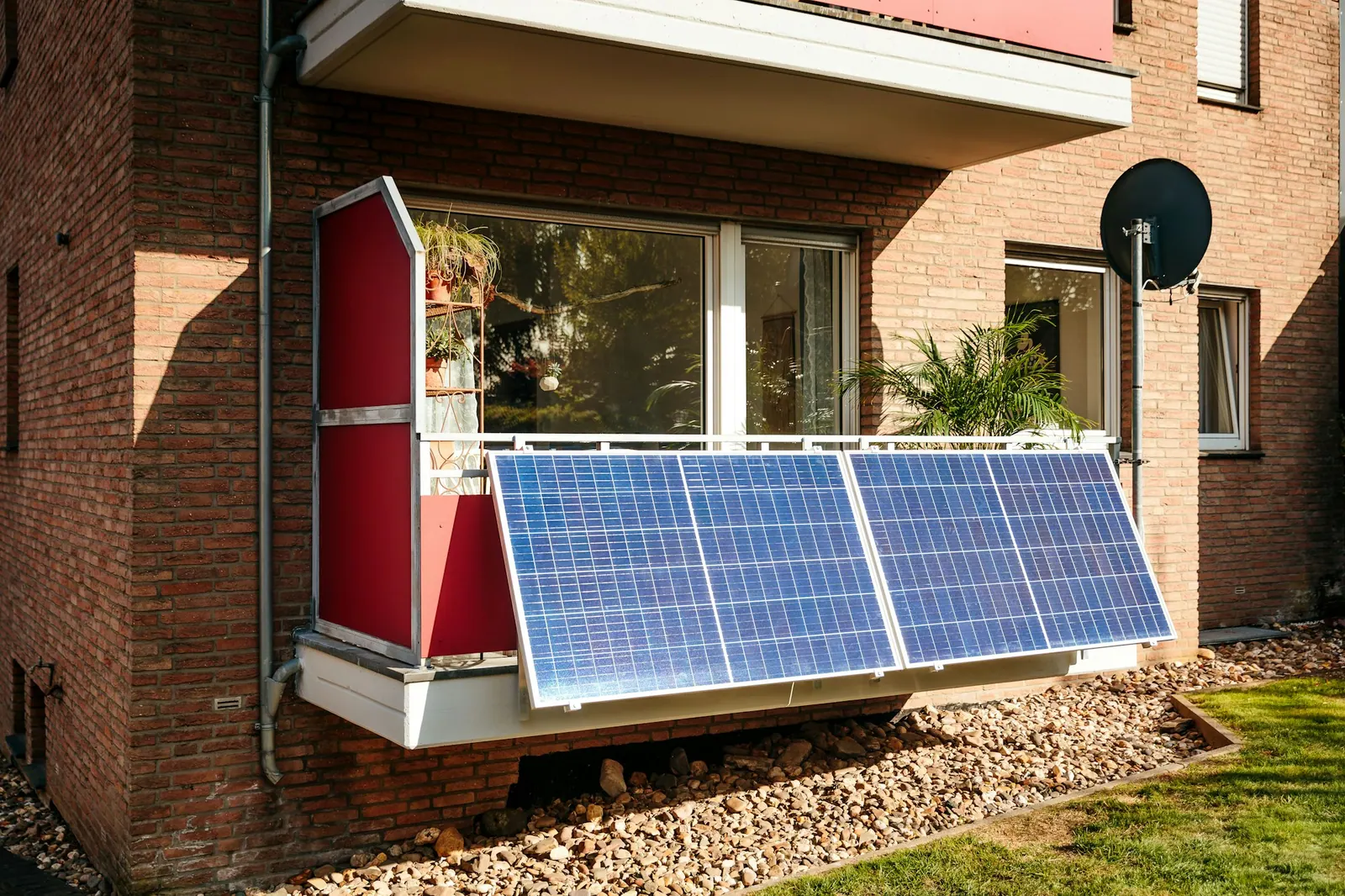
Plug-in solar panels for flats: the rules that apply
Plug-in solar is the one route a renter or leaseholder can start on their own. Two new laws made it legal in England, Scotland and Wales from 27 August 2026: SI 2026/848, which created the “plug-in microgenerator” category, and SI 2026/896, which added most kits to England’s permitted development rules. Northern Ireland isn’t covered yet.
To use the plug-in route, the kit must:
- Be on the ENA Type Test Register and declare compliance with the government’s Plug-in Solar Device Interim Product Specification.
- Have an inverter of no more than 800 VA. The panels can be rated higher, which helps on dull days.
- Have no battery. Kits with built-in or add-on storage are outside the rules, so a battery bundle is not a plug-in device, whatever the listing says.
- Plug straight into a wall socket with a factory-fitted UK 3-pin plug. No extension leads or adaptors.
You can run one device per household, and you must tell your distribution network operator when you connect it or take it down. In Kent and the rest of the South East, that is UK Power Networks.
Planning matters more in a flat than in a house. In England, a kit counts as permitted development unless it goes on a wooden balcony, timber-clad wall or fence, a listed building, or a road-facing wall or balcony in a conservation area. Panels on a wall or balcony can’t stick out more than 40 cm, or 20 cm where the wall faces a road. Plenty of newer blocks have timber or composite balcony decking, so check what yours is made of first. Our plug-in solar legal guide has the full list, and the compliance checker walks through it for a specific kit.
How much a plug-in kit makes in a flat
Less than the label suggests, because balcony panels usually hang upright. We ran the numbers in PVGIS 5.3, the EU Joint Research Centre’s solar model, for Maidstone, which gives 1,057 kWh a year per kWp facing south at 35 degrees. Hanging panels vertically cuts that to about 72%.
| Where the kit goes | 800 W kit (kWh a year) | Single 460 W panel (kWh a year) |
|---|---|---|
| Garden or flat roof, south, angled at 35 degrees | about 846 | about 486 |
| East or west, angled | about 668 | about 384 |
| South-facing balcony, panels vertical | about 609 | about 350 |
| North-facing balcony | not worth fitting | not worth fitting |
Source: PVGIS 5.3 for Maidstone, queried 18 November 2026, with our orientation factors. PVGIS puts Manchester at 886 kWh per kWp, so take about 16% off in the north of England.
What you save depends on how much of that you use as it is made. Exports earn nothing in most cases, because Smart Export Guarantee tariffs normally require an MCS-certified installation and a plug-in kit isn’t one.
| Share used at home | South balcony, 800 W (609 kWh) | South garden or flat roof, 800 W (846 kWh) |
|---|---|---|
| 40% (out at work all day) | about £64 a year | about £89 a year |
| 60% (home some weekdays) | about £96 a year | about £134 a year |
| 80% (home most days, daytime laundry) | about £128 a year | about £178 a year |
Savings at Ofgem’s price cap unit rate of 26.32p per kWh by Direct Debit, 1 October to 31 December 2026. Ofgem announces the January to March 2027 cap on 25 November 2026.
For a small flat this is a meaningful slice of the bill. Ofgem’s typical consumption figure for a one or two bedroom home is 1,600 kWh a year, so 365 kWh of balcony solar used at home covers almost a quarter of it. Fridges, routers, standby loads and a washing machine on a midday timer soak up most of the output. For payback maths on specific kits, see are plug-in solar panels worth it.
Approved plug-in kits that suit flats
These are the ENA-listed kits in our product records, all without batteries and with inverters capped at 800 VA. The mounting decides more than the wattage: several of the cheaper two-panel kits are not designed for balconies at all.
| Kit | Panels | Weight per panel | Mounting | Fit for a flat | Price (checked Nov 2026) |
|---|---|---|---|---|---|
| Octopus Energy Plug-in Solar (single panel) | 1 x 460 W | 22 kg | Ground stand or wall brackets | Deep balcony floor or masonry wall | £450 |
| EcoFlow STREAM Plug-in Solar Kit | 2, 1,000 W total | 26.6 kg (as listed) | Wall (facade brackets) | Masonry wall beside or below a balcony | £599 |
| Solarfy Duo 910 | 2, 910 W total | 22 kg | Flat mount | Ground-floor garden, patio or a flat roof you control; not for balconies | £509 to £549 |
| Thunder Energy Bolt 920W | 2, 920 W total | 21 kg | Garden, flat roof or shed | Garden or flat roof; flat-roof brackets extra | £749.99 |
| UKSOL Plug-In Solar Pro Duo 890W | 2, 890 W total | 25.5 kg | Hybrid ground mount | Larger gardens; UKSOL says not for balconies | £849 to £899 |
Specs and prices come from each manufacturer’s or retailer’s UK product page. Weight matters on a balcony: a 22 kg panel is a two-person lift and needs a fixing your landlord will accept. For the fuller shortlist, read our best plug-in solar panels and balcony solar panels guides, or the EcoFlow STREAM review.
Avoid “balcony power station” bundles that pair panels with a battery and an inverter output socket. Under SI 2026/848 a plug-in device must not be designed to store energy, so those products sit outside the plug-in route in Great Britain.
Asking your landlord or freeholder
The plug-in rules don’t override your tenancy or lease. Most tenancy agreements and leases forbid alterations to the exterior without consent, and the balcony railing is usually part of the structure. A short written request with the right detail gets a yes far more often than a vague one. Include:
- The exact product, with a link to the UK product page and its ENA register reference (for example OCTOQ/21124/V1/A5 for the Octopus single panel kit).
- How it fixes: clamps on the railing, a free-standing frame, or wall brackets. Say if no drilling is needed.
- Weight and wind load: the panel weight and the manufacturer’s fixing guidance.
- Electrical safety: one wall socket, no extension leads, and a recent EICR showing RCD protection. Landlords in England must have an Electrical Installation Condition Report at least every five years.
- Planning: confirm the balcony and wall aren’t timber and the building isn’t listed.
- Removal: you will take it down and make good when you leave, and notify the network operator.
Landlords with older blocks may also want a word with their building insurer. If the answer is no, a free-standing kit on a ground-floor patio, or a portable setup kept indoors, needs no consent at all.
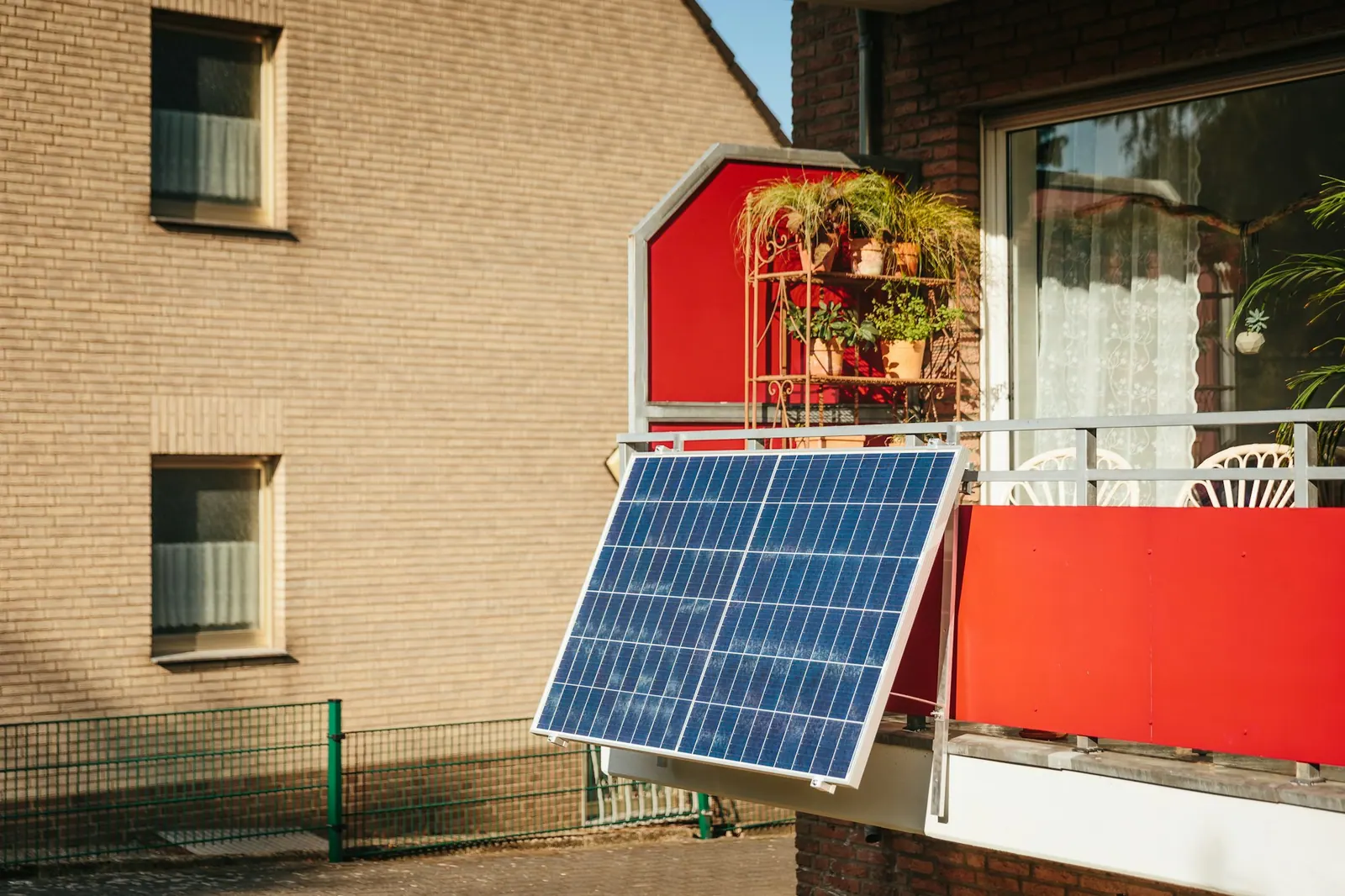
Shared rooftop solar for blocks of flats
If your building has a decent roof, shared solar is the bigger prize, but it has to be led by the freeholder, a housing association or a residents’ management company.
There are three common set-ups:
- Communal supply only. Panels power lifts, corridor lighting, door entry and pumps. The cheapest to install, and the saving shows up in the service charge rather than your own bill.
- Shared behind-the-meter systems. Equipment such as Allume’s SolShare splits one rooftop array between individual flats, so each home uses its share before buying from the grid. The UK Green Building Council lists installed costs of £1,500 to £3,500 per flat and allocations of 0.5 to 1.5 kWp each.
- Separate arrays per flat. Each flat gets its own panels and inverter wired to its own meter. Simple to bill, but cabling runs up through the building and roof space runs out quickly in taller blocks.
To put numbers on it, 1 kWp per flat in Maidstone makes about 1,057 kWh a year on PVGIS figures, about two thirds of Ofgem’s 1,600 kWh typical usage for a small home. That is why shared schemes deliver far bigger savings than a balcony kit.
Landlords have a reason to listen. Solar PV connected to a flat raises its EPC score, and the government has committed to private rented homes in England and Wales reaching EPC C by 2030. Social landlords may be able to use funding such as the Warm Homes schemes or ECO4. Our solar panel grants guide covers what is open now. A freeholder in Kent can get quotes through our Kent solar panel installers page.
Solar panels on a flat roof
Lots of people searching for solar for flats actually have a flat roof: a ground-floor flat with an extension, a maisonette, or a top-floor flat whose lease includes the roof. The Energy Saving Trust confirms flat roofs work well, with panels normally mounted on tilted frames to catch more sun.
Three things decide how much you can fit:
- Row spacing. South-facing rows tilted at 30 to 35 degrees cast long winter shadows, so the gap between rows can be as large as the rows themselves. Expect a tilted layout to cover roughly half the roof with glass.
- Edges and access. Keep clear margins around the edge, roof lights and drainage. The site’s working assumption is that about 70% of a roof is usable before shading gaps.
- Weight. Ballasted frames add weight, so an older roof deck may need a structural check.
A typical 440 W panel covers about 1.95 square metres. On a 20 square metre flat roof, a tilted south-facing layout might take four or five panels, around 2 kWp. Laying panels nearly flat or in low east and west facing rows packs more in, at about 83% of the output per panel on PVGIS figures for Kent. A two-panel plug-in kit such as the Solarfy Duo 910 or Thunder Energy Bolt 920W is the simple option if you just want to cover daytime use. For a full system, our how many solar panels do I need guide does the sizing.
On planning, permitted development in England covers many roof-mounted panels, but flat roofs have height limits and listed buildings and conservation areas add restrictions. If the roof belongs to the freeholder, you need their agreement whatever the council says.

Batteries, portable power and other routes
Home batteries. A battery can’t be part of a plug-in kit. A hard-wired home battery charged on a cheap overnight tariff can still cut bills in a flat with no solar at all, but it needs an electrician and the building owner’s agreement. Which? found prices from about £2,500 for a 5 kWh battery (October 2026). See our solar battery cost guide for the figures.
Portable panel and power station. This doesn’t connect to your home wiring, so the plug-in rules don’t apply, and no consent is needed if it stays on your balcony or windowsill. It won’t move your bill much, but it keeps phones, a router and lights going in a power cut. The EcoFlow RIVER 3 Plus (286 Wh) costs £219 to £319 and the Jackery Explorer 1000 Plus v2 (1,024 Wh) costs £569 on the brands’ UK sites, checked November 2026. Compare more in our best portable power stations.
Community energy. Local groups build solar on schools, farms and business roofs and sell shares to residents. You earn interest rather than cutting your own bill. Community Energy England keeps a directory of groups.
A renewable tariff. If you have no outside space at all, choosing a supplier backed by renewable generation is the simplest step, although it doesn’t lower your bill.
Which option suits your flat?
- South, south-east or south-west balcony with masonry walls: a wall-mounted or railing kit. Expect £95 to £130 a year if you use most of the output.
- Ground-floor flat with a garden or patio: a two-panel garden kit angled at the sun gives the best return of any plug-in option, around £134 a year at 60% self-use.
- North-facing, shaded or timber balcony: skip plug-in solar. Use a portable setup for resilience, or push for a building scheme.
- Leaseholder in a block with a large, unshaded roof: raise a shared rooftop scheme with the freeholder or residents’ association. It is slower, but it saves several times more than a balcony kit.
- Renting short term: choose a kit that clamps or stands, with no drilling, so it moves easily.
To estimate output for a full roof system on a house, try our solar calculator.
Try the solar calculator
Your estimate
£652 a year
Bill saving plus export income
- System size
- 4 kW (9 panels)
- Yearly generation
- 4,190 kWh
- Installed cost
- £6,500 to £7,400
- Payback
- 10 to 11.3 years
- Bill saving
- £275
- Export income
- £377
Used at home 25%Exported
Open the full calculator to add your roof size, usage and see monthly figures.